Ground to Crown
To take a ground to crown approach to wood is to work similarly to nose to tail in butchery: seeking high-value purposes for as much of a tree as possible.
I use irregular timber to describe wood whose bends, forks, taper and other variations remain part of the design. A tree fork offers a branching junction already formed during growth. Roundwood retains the rounded section of a stem instead of being sawn into a rectangular beam, while small-diameter timber includes slender stems and branches that may not suit conventional milling. These terms overlap; each draws attention to a different quality of the material.
Choosing a piece, recording its shape, deciding where to cut and finding a way to join it are all parts of design. The Weird Wood Index gathers buildings and assemblies that explore these possibilities, providing a wider context for the work described here.
For me, these ideas began to take shape around 2012, when I worked on a summer project with Emanuel Jannasch, a professor at Dalhousie Architecture. Looking back, that work was a starting point for questions I have kept returning to: what do the forms trees grow offer us, and how might we make more of them?
Those questions gained momentum in 2015–16 with the Tree Fork Truss at Hooke Park. It became our largest and most ambitious pursuit of these ideas: twenty naturally grown beech forks forming the structure of the Wood Chip Barn. Rather than making junctions from straight pieces, we worked with junctions the trees had already grown.
The truss brought forest selection, 3D scanning, structural design, robotic fabrication and assembly into one process. It also made clear how much depends on what happens before the first cut. A useful fork can be lost before it ever reaches a designer or maker; recognising its potential means working closely with the people who select, fell and process the trees. From tree scan to building component follows that journey in more detail.
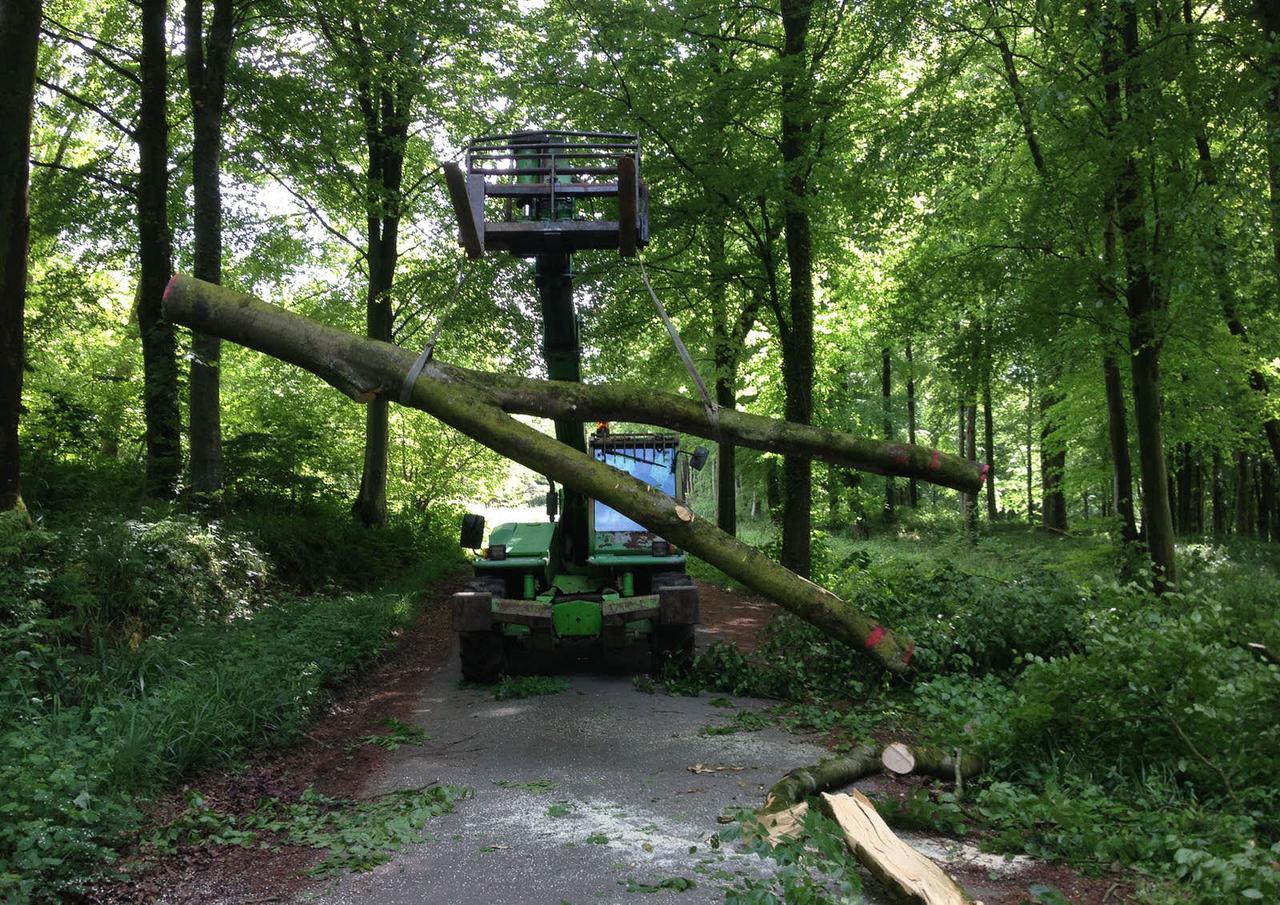
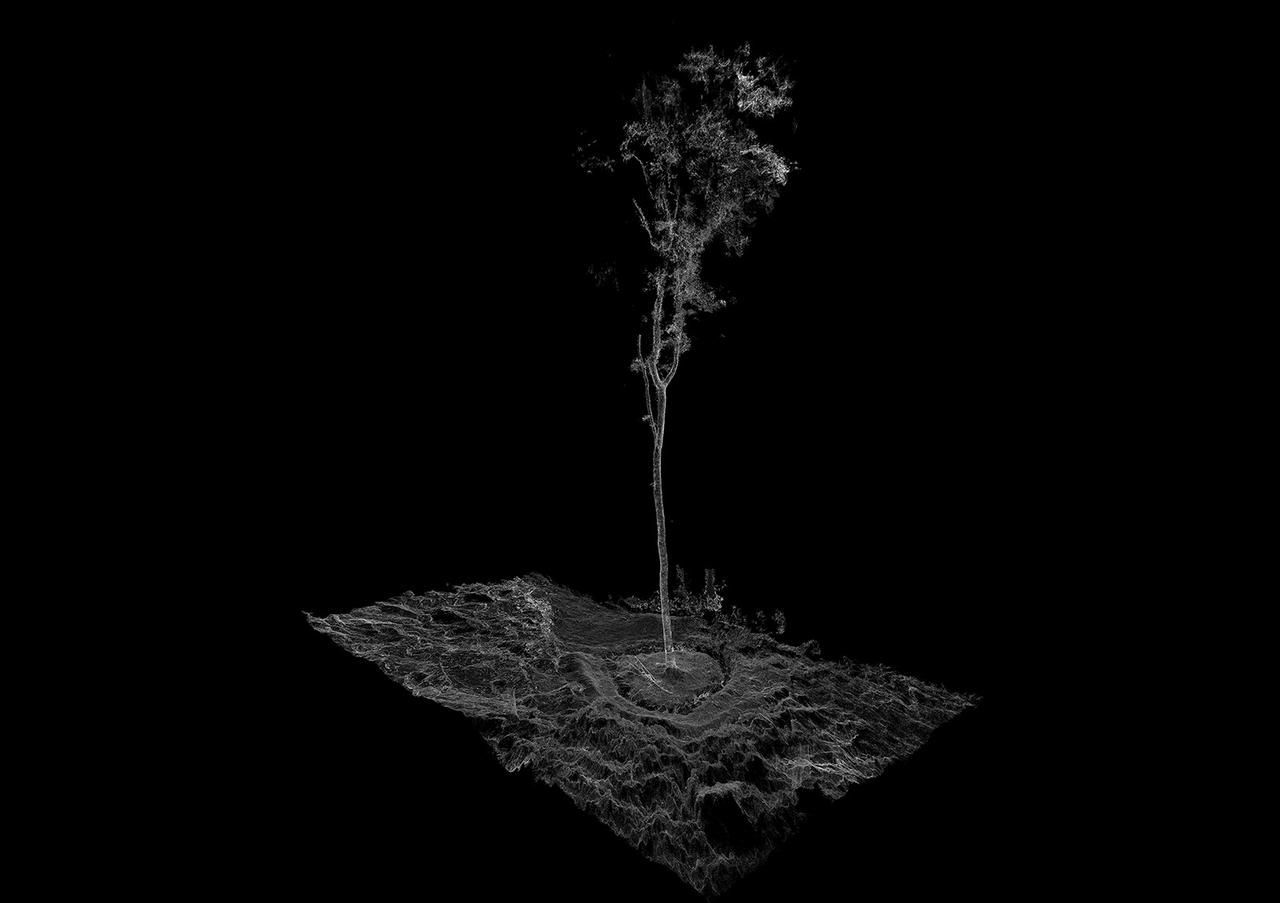
As my work moved into teaching, students broadened these questions. In 2018, Lucas Wilson's MSc Design + Make dissertation, An Ash Tree, took a single tree as the subject of a complete scan and study, from root tips to leaves. It invited us to consider the tree simultaneously as habitat, living plant and possible material, and to look beyond the parts we were already accustomed to using.
The name Ground to Crown came into my work in 2019 as the title of Patrick Birch's dissertation, written while he was one of my MSc Design + Make students. His work explored the structural possibilities of timber forms usually discarded, through projects including a bifurcated bridge and a beech fork stool. The title has stayed with me. Since then, it has become a wider theme and point of discussion running through almost all of my ongoing projects and those of my students.
In the Woodland Cabin, developed by Design + Make students in 2019–20, branching trees became both a structure and part of the experience of inhabiting a room. Robotic fabrication and hand-made joints worked together, with the trees' geometry helping to locate the building around them. The enquiry was extending from a structural junction into questions of space, furniture and everyday use.
At Daniels in 2023, Beech Thicket Build brought small-diameter beech trees from Haliburton Forest into the workshop. Students began by making their own mallets, then worked together on seating and larger pieces. The starting point was the material in front of them: measuring it, trying things and discovering what it could become. Across Using Trees Studio and other student projects, these conversations have continued to grow through different materials, scales and ways of working.
My 2024 exhibition Other Wood Pieces brought the conversation beyond forks and a few recognisable shapes. I gathered and prepared twenty-three uncommon pieces of wood, including bends, burrs, slices, salvaged beams and a piece of root, from at least ten species. They were presented as raw material for future designs, without each needing to demonstrate a particular use. Looking closely at each piece becomes a way to notice possibilities we might otherwise miss.
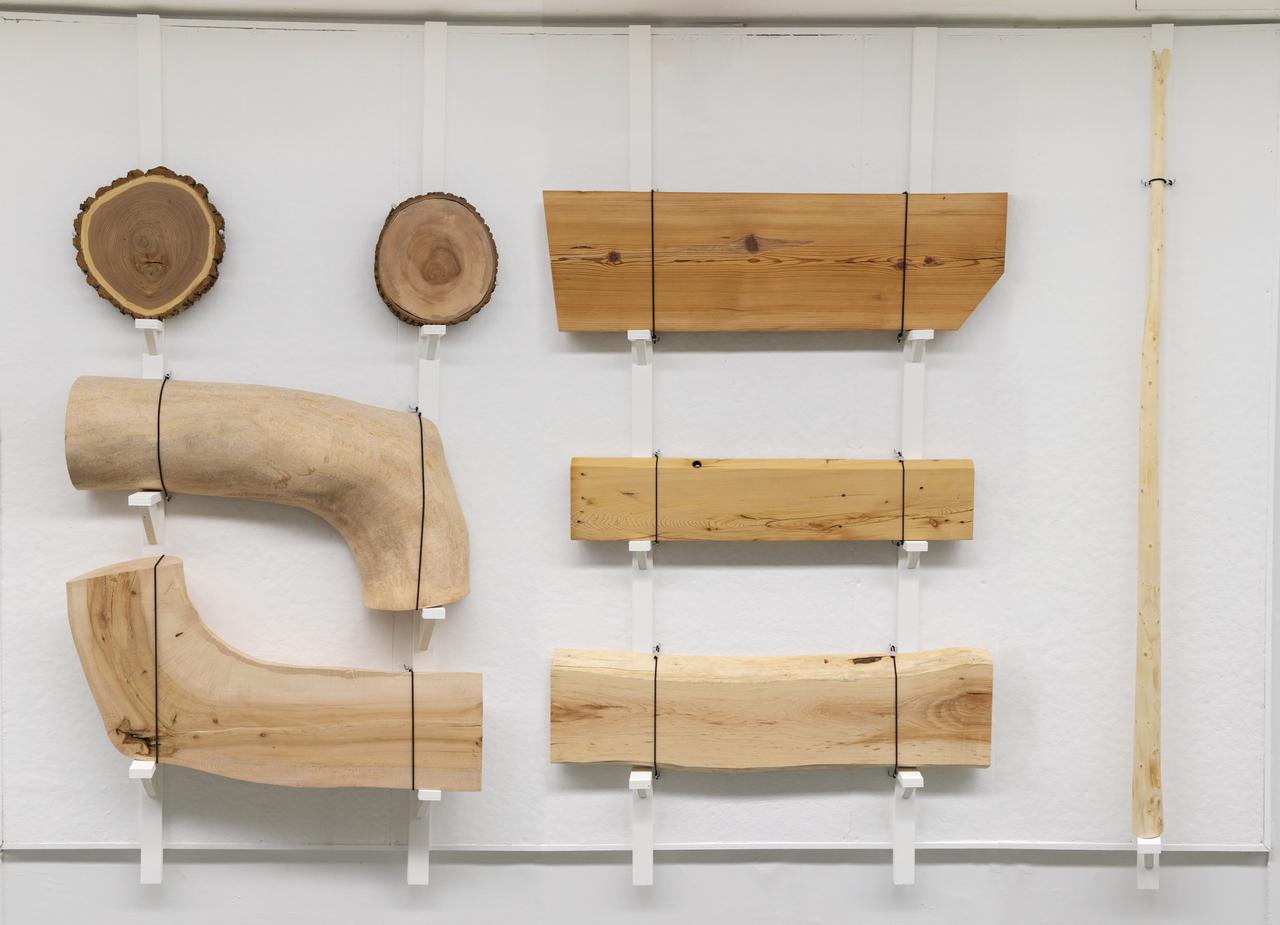
The pieces had come to me by many means: found in a grocery store parking lot, cut from the forest, passed on by my grandfather. Each had been obsessively prepared—dried, sawn, planed, peeled, carved and sanded. Working their surfaces was a way of looking as well as making. A cut or a planed face could reveal grain or a change in direction that had been difficult to see. Preparing a piece made it more familiar without fixing its future use.
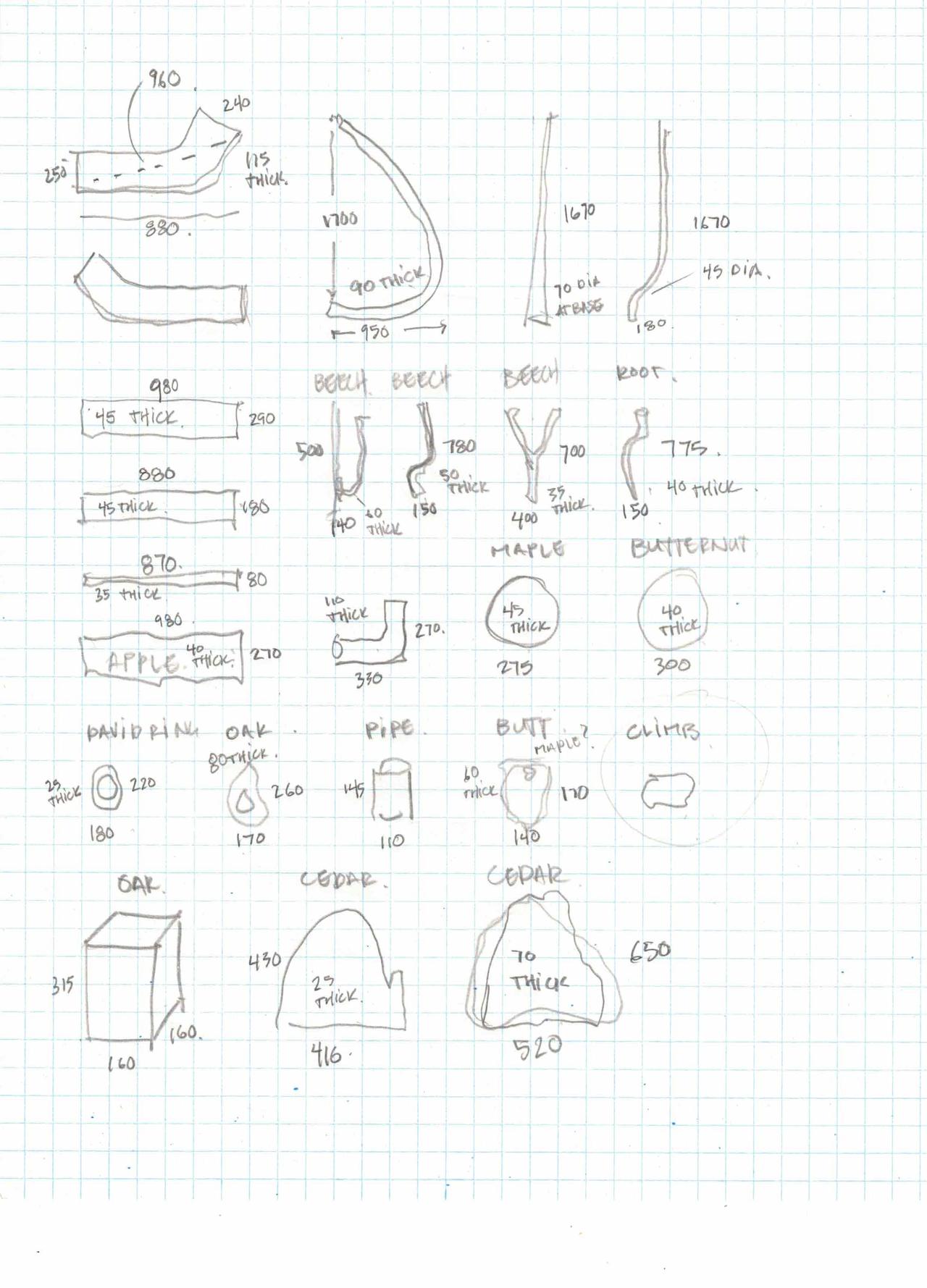
Drawing was another way to get to know the collection. My inventory sketches recorded each piece from different directions, noting its species, dimensions and particular form. They held questions as well as measurements: where a piece bends or branches, how its section changes, and what an exposed end reveals about the wood within.
The lecture and discussion with paleoclimate scientist Valerie Trouet that accompanied the exhibition opened these observations to other ways of reading trees. What can their rings tell us? How do we choose a piece for closer study, and which tools help us see it? These questions connect an interest in making with wood to the histories and living systems recorded within it.
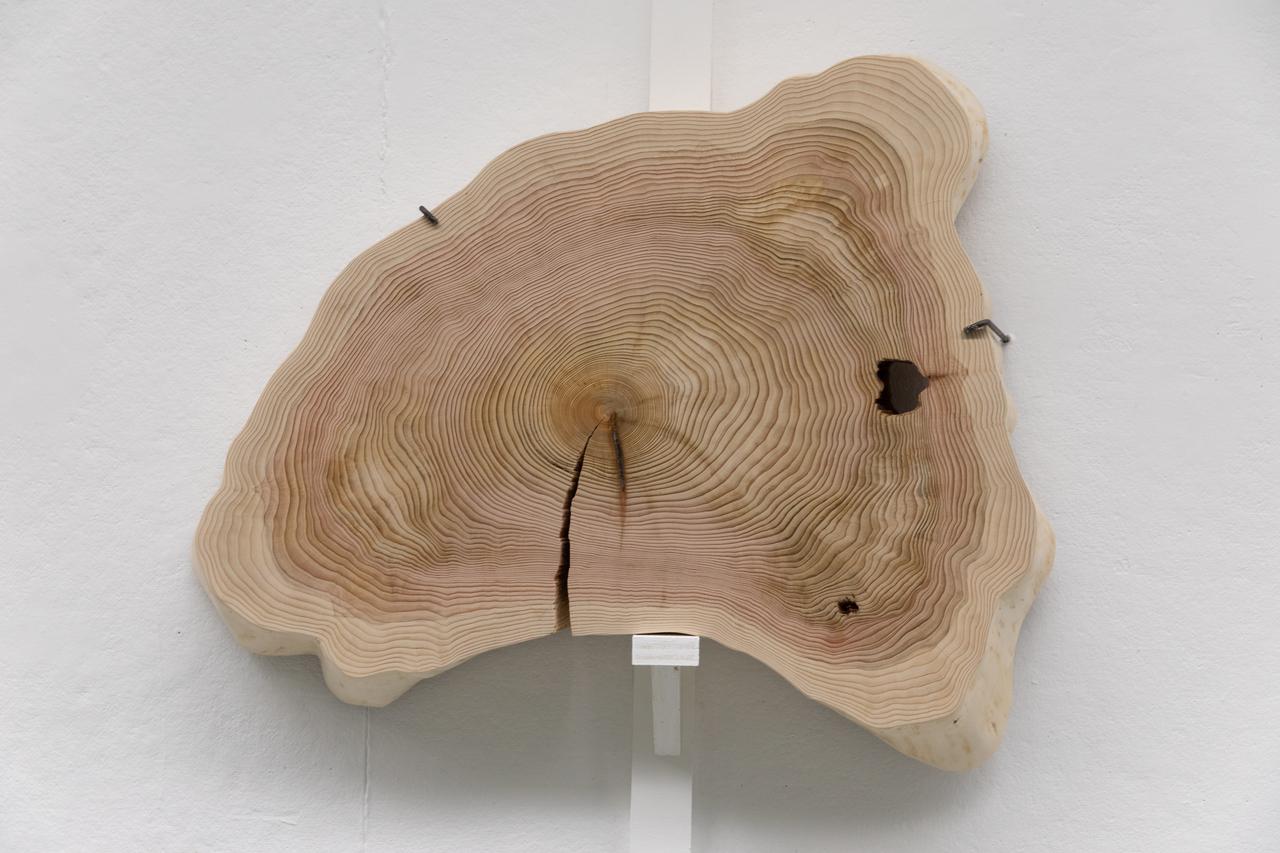
This broadens what ground to crown can mean for me. The timber industry already finds uses for offcuts and waste, but I am interested in looking for valuable purposes throughout a tree from the outset. A straight stem may suit sawn timber, a bend may suggest furniture, and smaller branches may provide tools or other objects. The more varied the things we know how to make, the more possibilities we can recognise—and the more reasons we have to value different trees and different parts of them.
Most recently, my colleague Maria Yablonina and I have reused the title Ground to Crown for a current research project at Haliburton Forest. It returns to the connection between recognising possibilities in a living tree and making those pieces available to work with. The project follows a tree from its standing form through felling, cutting and drying, comparing the pieces we recover with their earlier scans.